Less Time Scribing
An ambient AI scribe that refuses to fabricate your ED note.
Built by an ER physician
Excellent documentation.
Comprehensive billing.
Everything holds up.
- ED templates
- 84+
- Counted in the product template library.
- Chart render
- Under 60 seconds
- Target stated for a finished draft on this site.
" Omission is always preferable to fabrication. Every word in a clinical note is an attestation. "
What you get back
Your charts are done when you walk out the door.
No staying late to finish your notes. No charting at home after the shift. The work does not follow you home.
What you stop losing
Time and cognitive load.
Critical care, severity codes, procedures, and MDM support are handled in the note workflow.
What protects you
A patent-pending anti-fabrication engine.
Every provider entry is applied to chart context. The note reflects your input. No fabrications. No invented events.
No. 01 / The Principle
Ten reasons to look closer.
Emergency physicians do not need another polished paragraph generator. They need documentation support that respects the attestation burden.
More test results? Different patient trajectory? The chart keeps up.
Late entries, amended diagnoses, last-minute changes in disposition? No problem. The final note provides the final, correct version of the chart.
Intuitive documentation.
Critical care attestation, severity scores, and MDM language are added when the encounter supports them. Clinical content reflects only the information you provided.
Critical care documentation satisfies CMS requirements.
Time tracked automatically. Separately billable procedures pause the clock. The 99291 and 99292 you earned end up where they belong.
Procedure notes triggered by provider input.
POCUS doesn't show up because radiology ran an ultrasound. Intubation doesn't appear because the patient came in on a vent. No fabricated procedures.
Quality timestamps, captured automatically.
Door-to-EKG, door-to-imaging, antibiotic timing, last-known-well. Sepsis, stroke, STEMI, trauma. You don't chase the clock for your department's scorecard.
Risk scores automatically triggered, self-calculated.
HEART, sPESI, Wells, NIHSS, MELD. Triggered based on your dictation and data entry. Populated only when every component is present. No half-finished scores.
No MDM Boilerplate.
Captures everything required to maximize reimbursement. Reads as a credible account of your care. The MDM is the beating heart of the note.
Omits non-clinical conversations.
Phone calls about bed 7. Hallway conversations about the next admission. Shift change handoffs. You comment on your coworker's shoes. All discarded. The chart stays about the patient in front of you.
Automatic pediatric bias.
Weight-based dosing, age-appropriate vital signs, independent historian framing, applied automatically under eighteen. Above eighteen, the pediatric overlay is blocked. Adults not admitted.
Normal default no-touch physical exam, edited based on your abnormal findings.
Respiratory distress, nuchal rigidity, positive Rovsing sign, every abnormal finding removes a default and inserts your findings automatically.
From the ED
What physicians say after they sign the chart
Named quotes from people who use EDScribe Pro on shift.
“This app has changed the way I practice medicine. It captures details in the patient history, critical care time and other elements of the new CPT coding requirements that result in a complete note. It makes it possible for the patient to be the focus of my activities. I go home with all of my notes completed!”
Randell Chapman, MDEmergency Physician
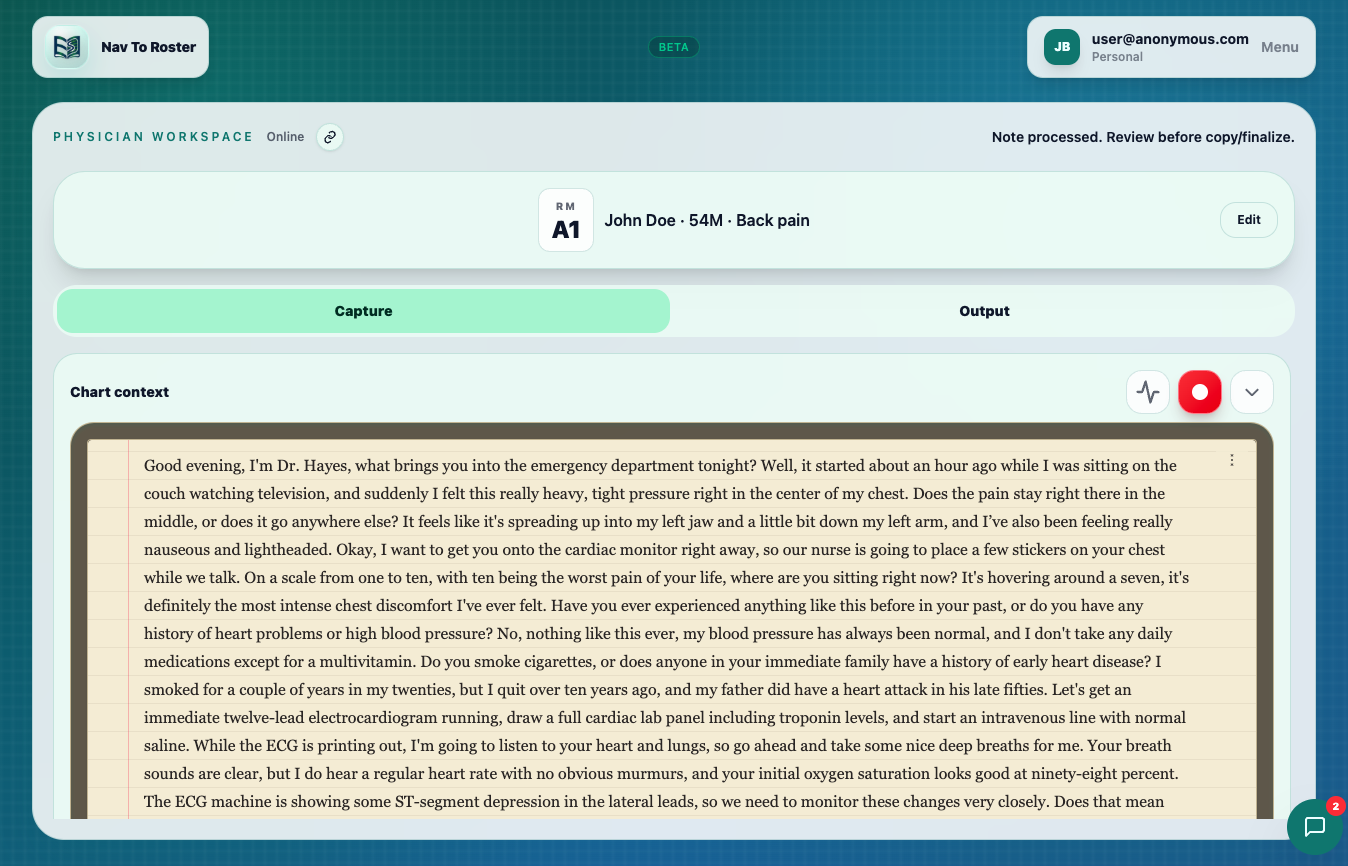
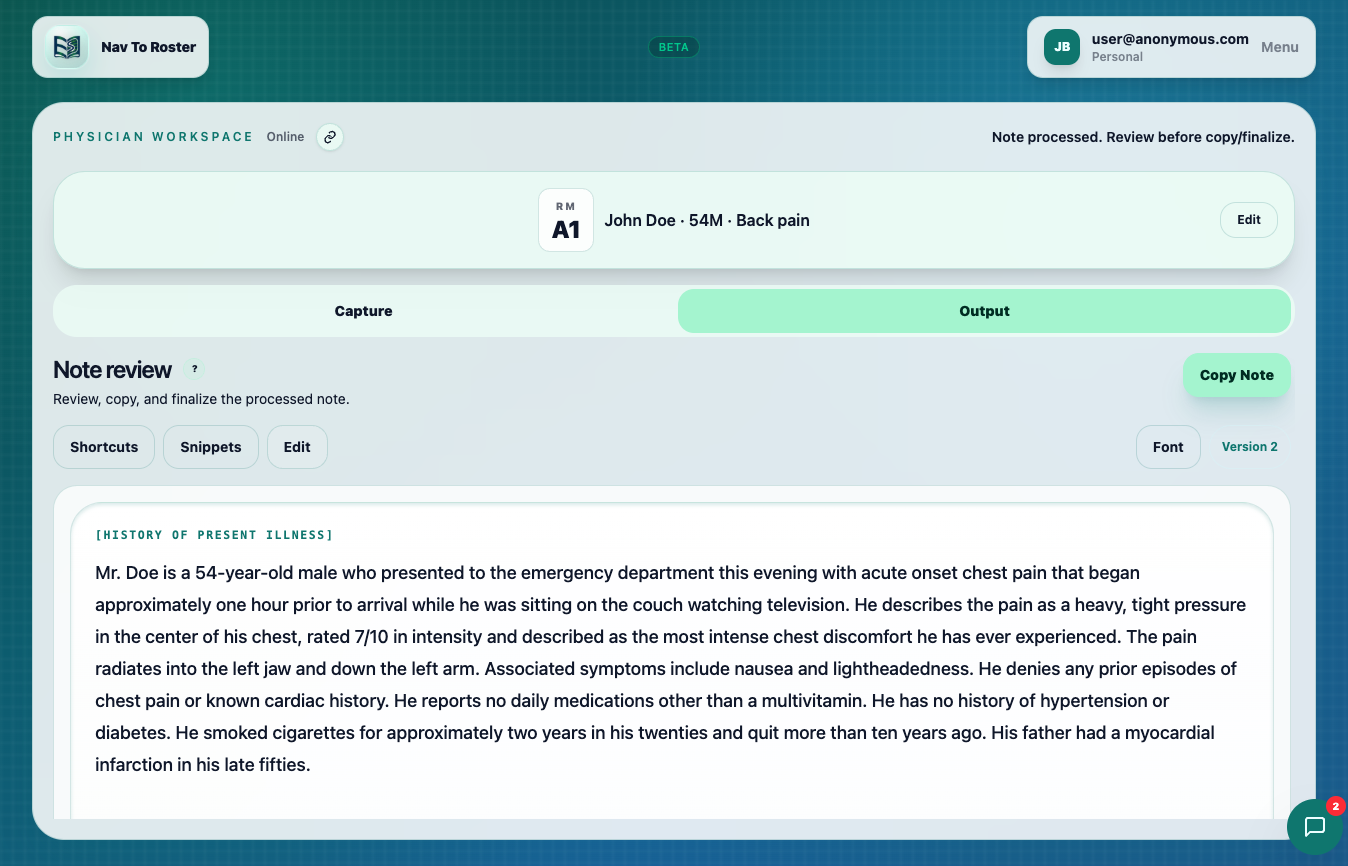
Sanitized Product Screens
What the note looks like with the identifiers left off
Product screens from the chart workspace. This is a demonstration chart. The account email is shown as user@anonymous.com.
What Makes It Different
Emergency medicine logic, not generic ambient transcription
The valuable parts of the existing site remain: MDM support, real ED template depth, field-free output, and physician-authored controls.
Built around the signed note
The chart must document the work without inventing the work.
EDScribe Pro treats documentation as a structured clinical product: instructions, macros, facility configuration, procedure content, and physician input each have their own lane.
ED template library
Real-shift coverage spans low-acuity injuries, sepsis, STEMI, critical care, pediatrics, and complex illness.
2023 E/M MDM support
The system is organized around documentation drivers physicians and groups actually need to defend.
Negative-qualifier suppression
Smart firing rules help keep inapplicable template language out of the chart.
Macro/IP separation
Clinical instruction, macro output text, facility configuration, and physician input remain distinct.
Direct review loop
EDScribe Pro supports physician judgment; it does not ask the physician to rubber-stamp blind automation.
Commercial flexibility
Standalone, group, and platform licensing paths can meet physicians, EM groups, and vendors where they are.
Who It Is For
Made for people who know the chart is a liability surface
Emergency physicians, EM groups, and ED platforms. Not outpatient clinics. Not inpatient services.
Emergency physicians
Reduce cleanup after a shift while keeping control of the words that enter the chart.
EM groups and CMOs
Improve consistency around MDM capture, documentation quality, and reviewable chart structure.
EHR and scribe platforms
License ED-tuned documentation intelligence instead of retrofitting general-purpose scribe output.
Trust
Designed for clinical data boundaries
HIPAA-eligible services, the BAA, encryption, and access controls are on the security page.
Comparisons
EDScribe Pro next to the scribes physicians name
Freed is the individual subscription. Abridge is the health-system scribe. The pages below put the buying motion and the note rule side by side.
EDScribe Pro vs Freed
A one-time chart pack for the ED, next to a monthly subscription for clinic notes.
Read the comparisonEDScribe Pro vs Abridge
An account an ED physician can open, next to a scribe sold to health systems.
Read the comparisonFAQ
Noise, hallway talk, and lines you did not dictate
How is the note kept to this encounter?
Ambient input is limited to what you captured for that patient. The note does not add events, procedures, or findings to fill a template. If your input does not support a line, the line stays out. Omission is preferable to fabrication.
What happens to hallway talk and other things I did not dictate?
Phone calls about another bed, hallway conversations, shift-change handoffs, and side comments are discarded. The chart stays about the patient in front of you.
What about noise and accents in a loud ED?
Side talk is discarded. The draft uses what you captured for that patient, and you review it before you sign. EDScribe Pro does not publish an accent or noise accuracy rate.
Status
In use on shift
Built for the moment before you sign.
Create your account. The first 20 charts are free. No credit card.